Camera angles in adult AI photography, and what each one means
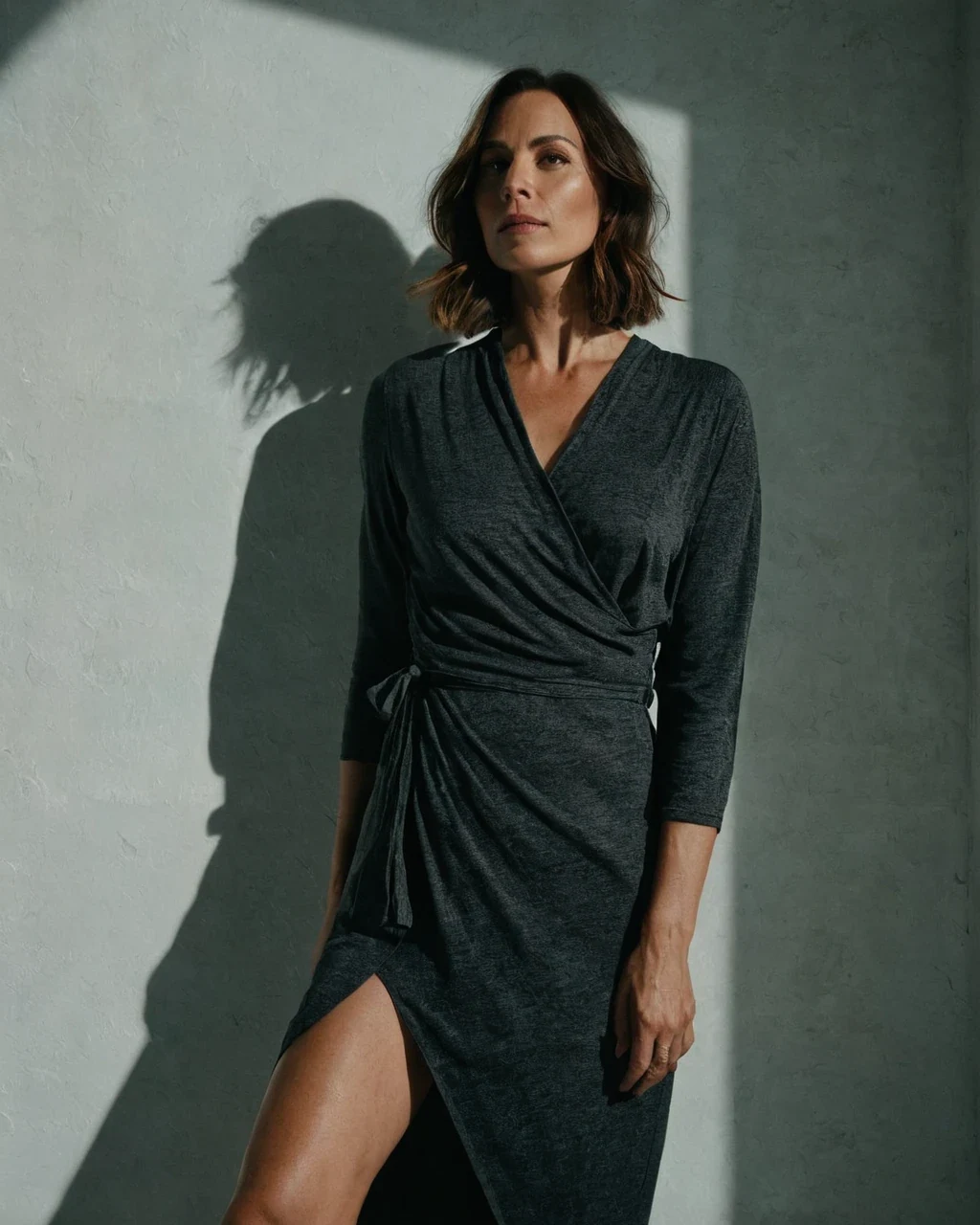
A brief with no camera in it hands the framing to the model, and the model picks a safe mid-shot at eye level every time. That is why so many renders feel like catalogue photography. Say where the lens is and the same subject becomes a photograph with a point of view. Try it in the studio.
Distance sets intimacy
How close the lens sits decides how much of the room competes with the person.
| Framing | Lens | Reads as |
|---|---|---|
| Close portrait | 85mm | Intimate, the face is the subject |
| Medium, waist up | 50mm | Neutral, the default for two people |
| Three-quarter | 50mm | Wardrobe and posture both legible |
| Full body | 35mm | The body in a place |
| Wide establishing | 24-35mm | The place, with a person in it |
Height sets power
Move the camera up or down and the same pose says something different.
- Low, looking up. Stature and dominance. Strong for a standing figure.
- Eye level. Neutral and documentary. The safe default, which is why it is dull when unchosen.
- High, looking down. Vulnerability and isolation.
- Over the shoulder. Puts the viewer in the room rather than outside it.
Move the camera before you move the subject
When a frame is not working, the instinct is to rewrite the pose. The camera is usually the cheaper fix, and it does not risk the casting - See holding one model.
- Same subject, three heights, three different photographs.
- A pose that reads stiff at eye level often reads deliberate from low.
- Change the camera clause alone so you can see what it did.
Where the camera clause goes
Near the end, after identity and action. It is a framing instruction, not a subject, and putting it early spends attention the casting needs. Pair it with one named light source - See colour and light.
Focal length changes the face, not just the frame
Distance and lens are separate decisions. Two frames can crop identically and still show two different faces, because the lens decides how much the nose leads the cheekbones.
24 to 35 mm
The room is the point. Features nearest the lens grow, so this is a body and environment choice rather than a portrait one. Step back and crop instead of shooting a face this wide.
50 mm
Close to how the scene looks to a person standing there. A safe default for three-quarter length work and for frames that must not look styled.
85 mm
The portrait standard. Features flatten into their true proportions and the background falls away. This is where most adult stock portraits belong.
105 to 135 mm
Compression becomes the effect. Backgrounds turn into colour, and the subject sits forward in the frame. Beautiful for beauty work, useless for showing a room.
| Lens | Camera distance | What it does to a face |
|---|---|---|
| 35 mm | Very close | Nose forward, ears back, wide jaw |
| 50 mm | Close | Roughly natural, mild forward bias |
| 85 mm | Medium | Even proportion, soft background |
| 135 mm | Far | Flattened, features stacked, background dissolved |
Let the deliverable pick the angle
Camera direction is a commercial decision as much as an aesthetic one. The buyer's layout usually decides it before taste does.
- A campaign hero wants eye level or slightly below, with quiet space above the head for a headline.
- A catalogue frame wants eye level and a longer lens, so the product is not distorted by perspective.
- An editorial portrait can take a low or high camera, because the point of view is part of the story.
- A social crop is square or vertical, so plan the angle around losing the sides. Contact-sheet planning decides these before the shoot.
Three things a camera clause should always name
A camera clause that names only a lens leaves three decisions to the model, and it will make all three.
Height
Below, at, or above the eye line. This is the single clause that decides whether the subject reads as dominant, level or observed.
Distance
Headshot, three-quarter, full length, or wide. Without it the lens number alone will not settle the crop.
Focus
What is sharp, and how much falls away. Both eyes sharp, background soft is a complete instruction and takes five words. The blueprint keeps it in one block.
Camera angles in adult AI photography, and what each one means: common questions
What phrase gives me a low camera angle?
"Low angle, camera below eye level, looking up" - Name the height and the direction together. "Dramatic angle" produces nothing repeatable.
Why do wide shots lose facial detail?
Because the face occupies fewer pixels, so there is less for the model to resolve. Use a wide shot for the place, and a separate close frame for the face.
Where in the brief should camera direction go?
After identity and action, near the end. Early placement takes attention the casting needs to hold together.
Which focal length should I default to?
85mm for a single portrait, 50mm for two people. Choose something else when you want what it does, not out of habit.
Does a longer lens really change a face?
Yes, though it is the camera distance doing the work. A long lens forces you further back, and that distance is what flattens the features.
What is the safest default for adult stock?
85 mm at eye level, three-quarter length, both eyes sharp. It is unremarkable in the best sense and almost never wrong for a portrait.
Should the aspect ratio go in the camera clause?
Yes. Crop and lens decide the composition together, so keeping them in one clause means you edit them together too.
Where to go next
This guide pairs with pose and camera together, camera in sequence and where camera goes in a prompt.